
Martha Raddatz and the faux objectivity of journalists http://nie.mn/RlvjPA

 The Guardian


5:50 PM - 12 Oct 12 · Details
Martha Raddatz and the faux objectivity of journalists
Establishment journalists are creatures of a highly ideological world and often cause ideology to masquerade as neutral fact
 Email
Email
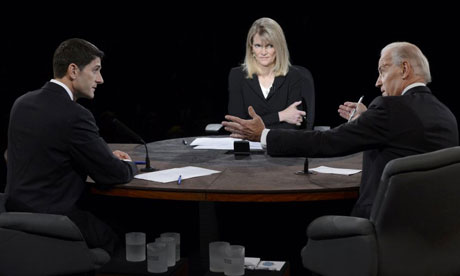
Martha Raddatz moderates the debate between Republican vice-presidential nominee Paul Ryan vice-president Joe Biden in Kentucky Photograph: Reuters
Numerous commentators (including me) were complimentary of the performance of Martha Raddatz as the moderator of Wednesday night's vice-presidential debate. She was assertive, asked mostly substantive questions, and covered substantial ground in 90 minutes. That's all true enough, but the questions she asked reveal something significant about American journalism in general and especially its pretense of objectivity.
For establishment journalists like Raddatz, "objectivity" is the holy grail. In their minds, it is what distinguishes "real reporters" from mere "opinionists" and, worse, partisans. As they tell it, this objectivity means they traffic only in straight facts, unvarnished by ideology or agenda. This journalistic code obligates them to speak only from what NYU journalism professor Jay Rosen, citing the philosopher Thomas Nagel, derides as "the View from Nowhere", a term Rosen explains this way:
Three things. In pro journalism, American style, the View from Nowhere is a bid for trust that advertises the viewlessness of the news producer. Frequently it places the journalist between polarized extremes, and calls that neither-nor position 'impartial'. Second, it's a means of defense against a style of criticism that is fully anticipated: charges of bias originating in partisan politics and the two-party system. Third: it's an attempt to secure a kind of universal legitimacy that is implicitly denied to those who stake out positions or betray a point of view. American journalists have almost a lust for the View from Nowhere because they think it has more authority than any other possible stance.
Leave aside whether that is even a desirable mindset. The reality is that, as desperately as they try, virtually no journalists are driven by this type of objectivity. They are, instead, awash in countless highly ideological assumptions that are anything but objective.
These assumptions are almost always unacknowledged as such and are usually unexamined, which means that often the journalists themselves are not even consciously aware that they have embraced them. But embraced them they have, with unquestioning vigor, and this renders their worldview every bit as subjective and ideological as the opinionists and partisans they scorn.
(In fact, one could reasonably make the case that those whose thinking is shaped by unexamined, unacknowledged assumptions are more biasedthan those who have consciously examined and knowingly embraced their assumptions, because the refusal or inability to recognize one's own assumptions creates the self-delusion of unbiased objectivity, placing those assumptions beyond the realm of what can be challenged and thus leading one to lay claim to an unearned authority steeped in nonexistent neutrality. That is why I believe that journalists who candidly acknowledge their opinions are better at informing others than those who conceal their opinions: conceal them either from others or, as is often the case, even from themselves.)
At best, "objectivity" in this world of journalists usually means nothing more than: the absence of obvious and intended favoritism toward either of the two major political parties. As long as a journalist treats Democrats and Republicans more or less equally, they will be hailed – and will hail themselves – as "objective journalists".
But that is a conception of objectivity so shallow as to be virtually meaningless, in large part because the two parties so often share highly questionable assumptions and orthodoxies on the most critical issues. One can adhere to steadfast neutrality in the endless bickering between Democrats and Republicans while still having hardcore ideology shape one's journalism.
The highly questionable assumptions tacitly embedded in the questions Raddatz asked illustrate how this works, as does the questions she pointedly and predictably did not ask. Let's begin with Iran, where Raddatz posed a series of questions and made numerous observations that she undoubtedly believes are factual but which are laden with all sorts of ideological assumptions. First there is this:
RADDATZ: Let's move to Iran. I'd actually like to move to Iran, because there's really no bigger national security...RYAN: Absolutely.RADDATZ: ... this country is facing.
Ryan's interruption made it difficult to hear whether Raddatz said that there is "no bigger national security threat the country is facing" or "national security issue". Either way, the very idea that Iran poses some kind of major "national security" crisis for the US – let alone that there is "really no bigger national security" issue "this country is facing" – is absurd. At the very least, it's highly debatable.
The US has Iran virtually encircled militarily. Even with the highly implausible fear-mongering claims earlier this year about Tehran's planned increases in military spending, that nation's total military expenditures is atiny fraction of what the US spends. Iran has demonstrated no propensity to launch attacks on US soil, has no meaningful capability to do so, and would be instantly damaged, if not (as Hillary Clinton once put it) "totally obliterated" if they tried. Even the Israelis are clear that Iran has not even committed itself to building a nuclear weapon.
That Iran is some major national security issue for the US is a concoction of the bipartisan DC class that always needs a scary foreign enemy. The claim is frequently debunked in multiple venues. But because both political parties embrace this highly ideological claim, Raddatz does, too. Indeed, one of the most strictly enforced taboos in establishment journalism is the prohibition on aggressively challenging those views that are shared by the two parties. Doing that makes one fringe, unserious and radical: the opposite of solemn objectivity.
